
Guides
All-on-4 vs All-on-6: when fixed teeth or overdentures make sense
Compare four and six implants, fixed teeth and overdentures using clinical evidence, maintenance needs and the costs a full-arch quote should include.
By MedicCN, Editorial research · Medically reviewed by Dr. Jiang Haiyang · published 2026-09-26 · sources checked 2026-09-26
Medically reviewed by Dr. Jiang Haiyang, MedicCN Co-founder and Chief Medical Officer. Checked against the linked sources on 26 September 2026. This article explains treatment terminology and evidence; it does not determine whether teeth should be removed or which reconstruction suits an individual.
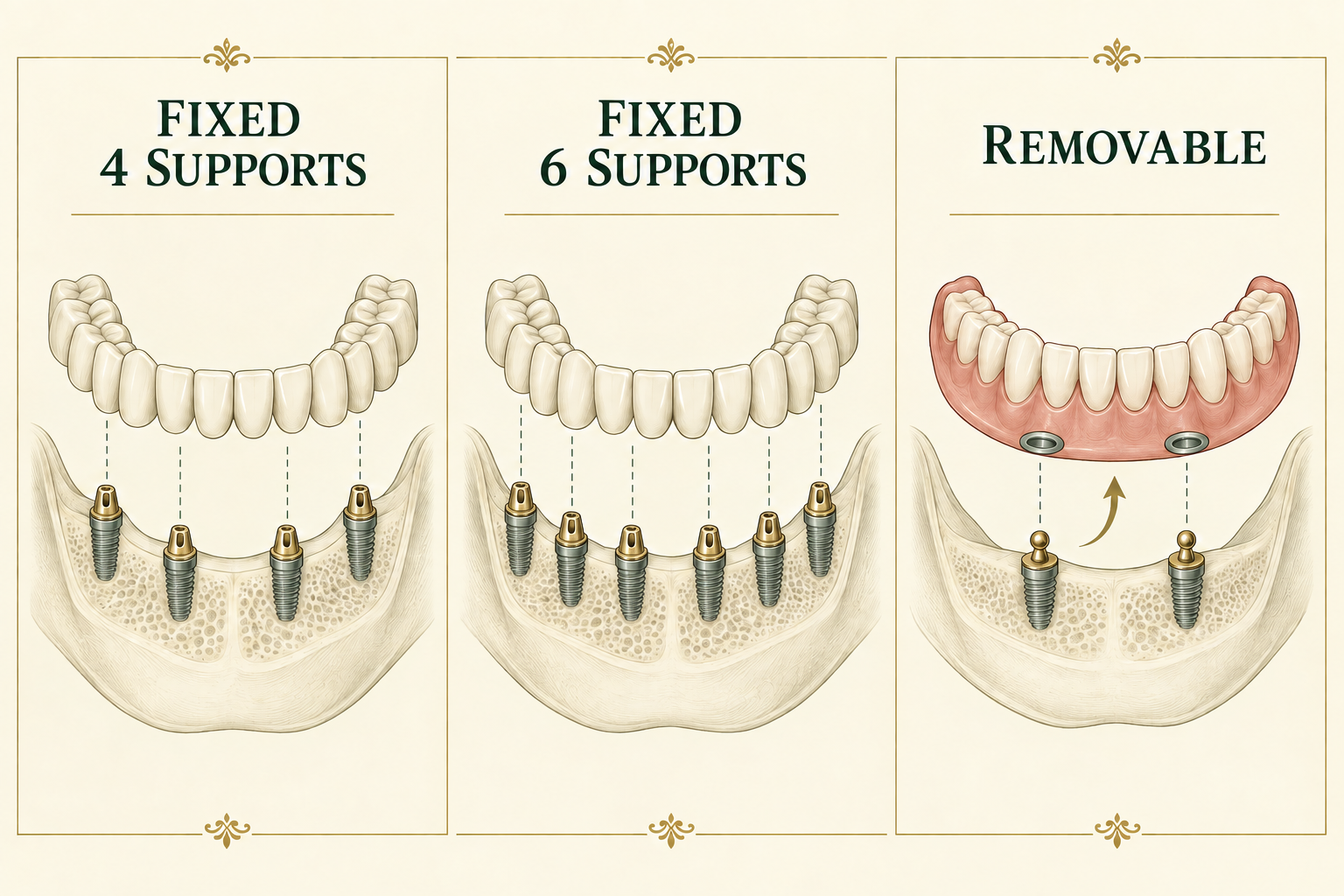
Four, six or removable: what actually changes
Four and six implants can both support a fixed full arch. Randomised upper-jaw trials have not established a survival advantage for six; implant distribution, prosthesis design and maintenance remain consequential. Overdentures offer a different arrangement: the patient removes the teeth for cleaning while the implants remain in place.
The number describes supports in one jaw, not replacement of both jaws. A fixed bridge is removed by the clinical team; an overdenture is retained by attachments and may receive support from the implants alone or from implants and the underlying tissues. Lip support, restorative space and cleaning access are part of the design—not cosmetic extras.
| Design | Daily use | Main trade-off |
|---|---|---|
| Four-implant fixed arch | Not removed at home | Fewer implant sites; position and unsupported bridge length matter |
| Six-implant fixed arch | Not removed at home | More support sites; requires suitable bone and surgical planning |
| Implant overdenture | Patient-removable | Direct access for cleaning; attachments need maintenance |
Five-year trials separate implant survival from repairs
Two small randomised trials in the upper jaw found high implant survival with both counts. Their results do not support selling six implants as a universal longevity upgrade. The more informative distinction is whether the implant remains, whether the bridge remains and whether either needs intervention.
In Tallarico and colleagues’ five-year trial, all 40 patients completed follow-up. One of 80 implants failed with four supports, compared with six of 120 with six supports; no prosthesis failed. The between-group implant-failure difference was not statistically significant (p = 0.246). Thus, an implant failure did not necessarily mean loss of the whole bridge.
Toia and colleagues’ 2025 report included 47 patients and 233 implants. Four supports were non-inferior for five-year marginal-bone change; implant survival was 100% versus 99.3%. Technical complications were more frequent with four, while initial and total costs were lower. The manufacturer-supported study concerned maxillary treatment; these findings do not settle lower-jaw designs or lifelong maintenance.
Bone, remaining teeth and restorative space determine candidacy
A fixed full arch needs implant positions that support the proposed teeth, not merely enough room to insert a given number of screws. The ITI consensus recommends at least four appropriately distributed implants for a one-piece fixed arch. Bone distribution, the bridge’s unsupported extension and the possibility of augmentation shape the actual plan.
Where teeth remain, their prognosis is an earlier decision. The EFP’s stage IV periodontitis guideline includes disease control and the feasibility of retaining teeth in rehabilitation planning; advanced periodontal disease does not automatically justify clearing the arch.
Removable implant teeth can also produce substantial improvements. A 2023 systematic review of 28 studies and 1,457 patients found benefit with both fixed and removable designs, with better stability ratings for fixed teeth. The comparable 1–1.5-year data were much smaller—40 fixed versus 500 overdenture patients at baseline—with moderate or low certainty. The result supports treating removability as a design choice rather than equating it with poor quality.
A lasting bridge can still need substantial maintenance
A 2026 Mainz cohort followed 91 fixed full-arch prostheses in 72 patients for an average of 6.8 years. Seven prostheses failed, giving 92.3% overall survival, yet only 49.5% remained complication-free. These figures describe prostheses over variable follow-up—not a patient’s predicted risk at a fixed year.
Veneer fracture was the most frequent technical problem. Resin- and ceramic-veneered restorations had similar overall survival, but ceramic veneers had better fracture-free survival. This was retrospective evidence from metal-framework designs, not a randomised comparison of every modern zirconia option.
Material therefore belongs in the repair discussion as well as the purchase price. The implant, connecting components and visible bridge are different parts of the reconstruction. A chipped surface, worn attachment or loose component may need treatment while the supporting implant remains functional. Biological maintenance is separate: plaque control, tissue examination and risk-based review remain necessary with every material.
Immediate teeth and the final reconstruction are different stages
Immediate placement means placing an implant into an extraction socket; immediate loading means using it to support a restoration early. Neither guarantees delivery of the definitive bridge. Early loading depends on conditions including initial stability, so a provisional and a fallback healing plan are part of the treatment design.
In a conventional staged pathway, bone integration commonly takes two to six months before use. Leeds Dental Institute describes subsequent impressions, temporary restoration to check shape and tissues, then further impressions and final work over several visits. Extensive grafting can add a separate earlier stage. Immediate-loading full-arch cases follow a different timetable, but still require review and restorative planning.
A full-arch quotation therefore has to identify one jaw or both, the provisional bridge, the definitive material, augmentation and maintenance. Four implants with the final bridge included cannot be compared directly with six implants quoted only through surgery. The treatment’s endpoint and the cost of keeping it serviceable matter more than the advertised implant count.