
Guides
Medical care in Asia: how Japan, Korea, Singapore, Thailand and China compare
Compare five Asian healthcare systems: doctors and beds, specialist concentration, published cardiac and stroke outcomes, self-pay fees and overseas patient access.
By MedicCN, Editorial research · Medically reviewed by Dr. Jiang Haiyang · published 2026-09-26 · sources checked 2026-09-26
Medically reviewed by Dr. Jiang Haiyang, MedicCN Co-founder and Chief Medical Officer. OECD, WHO, World Bank and national government sources checked on 26 September 2026. Observation years are shown separately; resource indicators do not establish treatment quality.
Five countries, five different ways of organising care
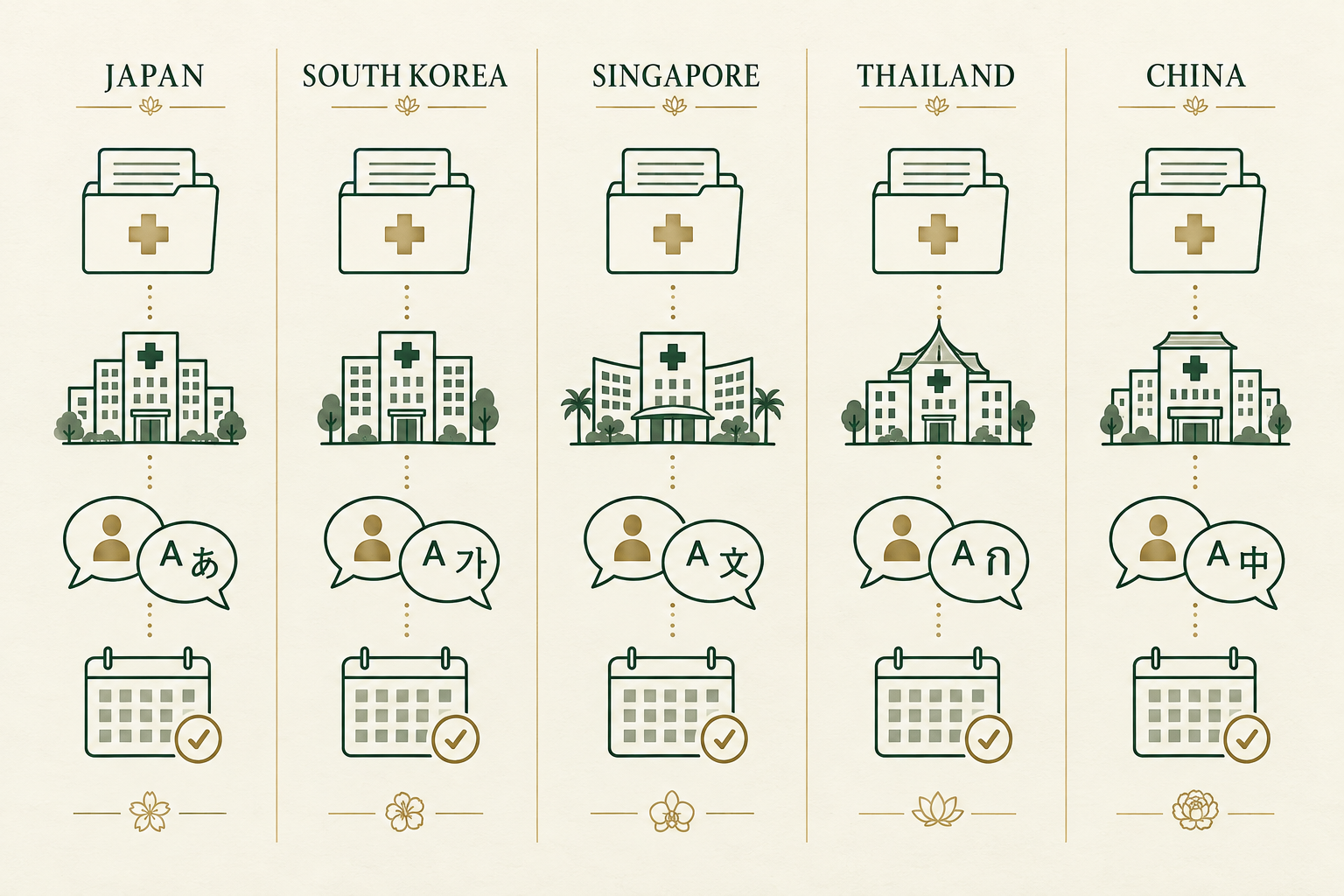
Japan and Korea have much greater hospital-bed capacity per resident than the other three countries. Singapore combines a compact national specialist network with public fee references. China concentrates nearly half its hospital beds in its tertiary tier, while Thailand combines a resident universal-coverage system with a separate private-care market. These differences shape where an overseas patient enters the system and how the bill is calculated.
| Country | How specialist resources are organised | What changes for an overseas patient |
|---|---|---|
| Japan | Extensive hospital infrastructure; designated cancer-care network | Medical-stay visa uses a registered guarantor and hospital documentation; visitor charges can differ from insured tariffs |
| South Korea | Predominantly private provision within a national insurance system | A national registration system identifies providers authorised to attract foreign patients |
| Singapore | Ten national specialty centres alongside public and private hospitals | Government bill data and private fee benchmarks help interpret a procedure quote; visitor subsidies differ |
| Thailand | Public coverage network alongside private hospitals | Resident coverage does not set a medical tourist’s price; private charges need to be assessed separately |
| China | Tertiary hospitals hold about 48% of hospital beds (2024) | Public hospital prices are government-guided; non-public providers use market pricing |
Capacity matters most when you know where it sits
Japan and Korea each report more than twelve hospital beds per 1,000 people, compared with fewer than three in Singapore and Thailand. Doctor density is much closer across Japan, Korea, Singapore and China. A large bed stock therefore does not necessarily mean more specialist time per patient.
The table separates observation years rather than relabelling old data as 2026 figures. Doctors include generalists and specialists; hospital beds also serve rehabilitation and longer-term care. Spending uses 2023 purchasing-power-adjusted international dollars. Singapore’s higher spending describes the resources consumed by its health system, not a visitor’s treatment price.
China’s structure is particularly easy to misread from hospital counts. In 2024, 4,111 of its 38,710 hospitals were tertiary institutions: roughly 11% of hospitals held 48% of hospital beds. The tertiary tier is therefore central to a search for hospital-based specialist care. The figures describe concentration by institutional level; they do not mean every tertiary hospital offers the same procedures or outcomes.
Ownership also means different things across borders. An OECD review published in 2022 reported that about 94% of Korean hospitals were privately owned. Private provision there is part of the mainstream insured system. Singapore, by contrast, identifies ten national specialty centres spanning fields including cancer, heart disease, eye care, neuroscience and dentistry. These named centres give an overseas patient a more explicit specialty map than a general list of hospitals.
Thailand’s WHO workforce profile describes geographical and sectoral imbalances, with professionals concentrated in urban areas and the private sector. Its national doctor average should not be used to describe the staffing of a Bangkok private hospital. Conversely, the services of a prominent international hospital cannot stand in for healthcare access across Thailand.
| Country | Doctors / 1,000 people | Hospital beds / 1,000 people | Health spending / person, PPP (2023) |
|---|---|---|---|
| Japan | 2.7 (2022) | 12.6 (2022) | 5,365 |
| South Korea | 2.6 (2022) | 12.8 (2022) | 4,798 |
| Singapore | 2.6 (2021) | 2.8 (2023) | 6,551 |
| Thailand | 0.9 (2020) | 2.4 (2023) | 1,067 |
| China | 2.5 (2021) | 5.6 (2023) | 1,487 |
What comparable cardiac and stroke outcomes show
Japan reports the lowest stroke fatality of these three reporting countries in the OECD/WHO series. This is more clinically meaningful than counting beds, but it measures acute hospital care—not the success rate of an elective operation.
These are age- and sex-standardised deaths per 100 admissions among people aged 45 or older, within 30 days and in the same hospital. Transfers and deaths after discharge are not fully captured. Case severity, emergency transport and discharge practices also affect the comparison. China and Thailand are absent from these harmonised figures; substituting a selected hospital study would make the comparison misleading.
| Country / observation year | Acute myocardial infarction | Ischaemic stroke | Haemorrhagic stroke |
|---|---|---|---|
| Japan (2020) | 8.3 | 2.9 | 11.4 |
| South Korea (2021) | 8.4 | 3.3 | 16.0 |
| Singapore (2021) | 9.9 | 4.2 | 19.1 |
The price framework differs more than a headline package suggests
Singapore publishes procedure-level bill references and private fee benchmarks; China separates government-guided public prices from market-priced non-public care. Japan’s insured tariff is a useful reference, but it is not a universal visitor tariff. These are materially different starting points for comparing costs.
Singapore’s Ministry of Health lets patients search by condition or procedure code. Its published private hospital benchmarks apply to specified services and, for inpatient hospital fees, one-bedded wards; doctor fees and hospital fees need to be distinguished. Unusually complex or severely ill cases can fall outside the reference scope. The practical advantage is a government reference against which an itemised quote can be read, rather than a guaranteed all-inclusive price.
Japan illustrates why “the national price” needs qualification. Insurance fees normally use ¥10 per point. A March 2026 rule allows specified hospital corporations, including social medical corporations, to set uninsured foreign-visitor prices up to ¥30 per point, subject to a regional standard ceiling and administrative confirmation. This is a narrowly defined rule for those corporations, not a nationwide threefold surcharge or a cap applying to every provider.
China’s public medical-service prices are government-guided and administered through regional pricing arrangements. Non-public institutions use market-adjusted prices. A public hospital’s ordinary service, its international service and a private hospital therefore need not share one tariff. The financing model also leaves separate components such as medicines and consumables: the listed price of a procedure is not automatically the complete episode cost.
Thailand’s Department of Internal Trade describes a national reporting framework covering hospital medicine and supply prices, medical-service fees and other charges. Its 2024 report also describes informing patients of prices before sale or service on request. This provides a basis for price disclosure, rather than one national treatment tariff. In Korea, national insurance and predominantly private ownership coexist; neither ownership nor an insured fee schedule establishes what an uninsured visitor will be charged.
- Singapore MOH: searchable bills and benchmarks
- Singapore MOH: benchmark scope effective January 2025
- Japan MHLW: specified corporations’ visitor pricing, March 2026
- China NHSA: public medical-service pricing
- China NHC: non-public medical-service pricing
- Thailand DIT: Annual Report 2024
- OECD: Korea financing and provision
Overseas access follows a different path from resident coverage
Japan makes the medical-stay visa pathway explicit; Korea regulates institutions attracting foreign patients through registration. Singapore’s public specialist infrastructure is available within a system whose subsidies distinguish citizens and permanent residents. In Thailand and China, the difference between resident coverage and self-funded international care is equally important.
For Japan’s medical-stay visa route, the applicant works through a registered guarantor and supplies a hospital certificate describing the planned care, a guarantor reference and evidence of financial means. Stays exceeding 90 days require hospitalisation and a Certificate of Eligibility. These rules describe that visa route; they do not mean every visitor receiving care must use it. Japan’s designated cancer-hospital network and international-patient directories provide separate tools for locating services.
Korea requires registered medical providers serving foreign patients to carry malpractice-liability insurance. Registration status can also be checked separately for facilitators; it does not certify comparative treatment results. National Health Insurance eligibility is a separate matter based on employment or qualifying residence status, including a six-month residence rule for many local subscribers. A short medical trip should not be budgeted as if the patient had resident benefits.
Singapore’s public acute-inpatient subsidies are for citizens and permanent residents. Being admitted to a public institution does not give an overseas visitor those subsidies. Thailand’s universal-coverage arrangements likewise concern eligible populations rather than automatically insuring medical tourists. In China, eligible foreign employees participate in social insurance, but an overseas self-pay patient has a different financial position. International services may add translation and coordination to a hospital visit; those services and their charges must be distinguished from the underlying clinical department.
The strongest national-level distinction is therefore practical: Japan offers a formal medical-stay coordination route; Korea a regulated foreign-patient recruitment channel; Singapore a clearly mapped specialist network and published fee references; Thailand a dual public-coverage and private-care environment; China a large tertiary-hospital base with regionally administered public pricing. Those differences establish the search strategy before individual hospitals enter the comparison.