
Guides
What does Class 3A mean? Seven things patients get wrong about Chinese hospitals
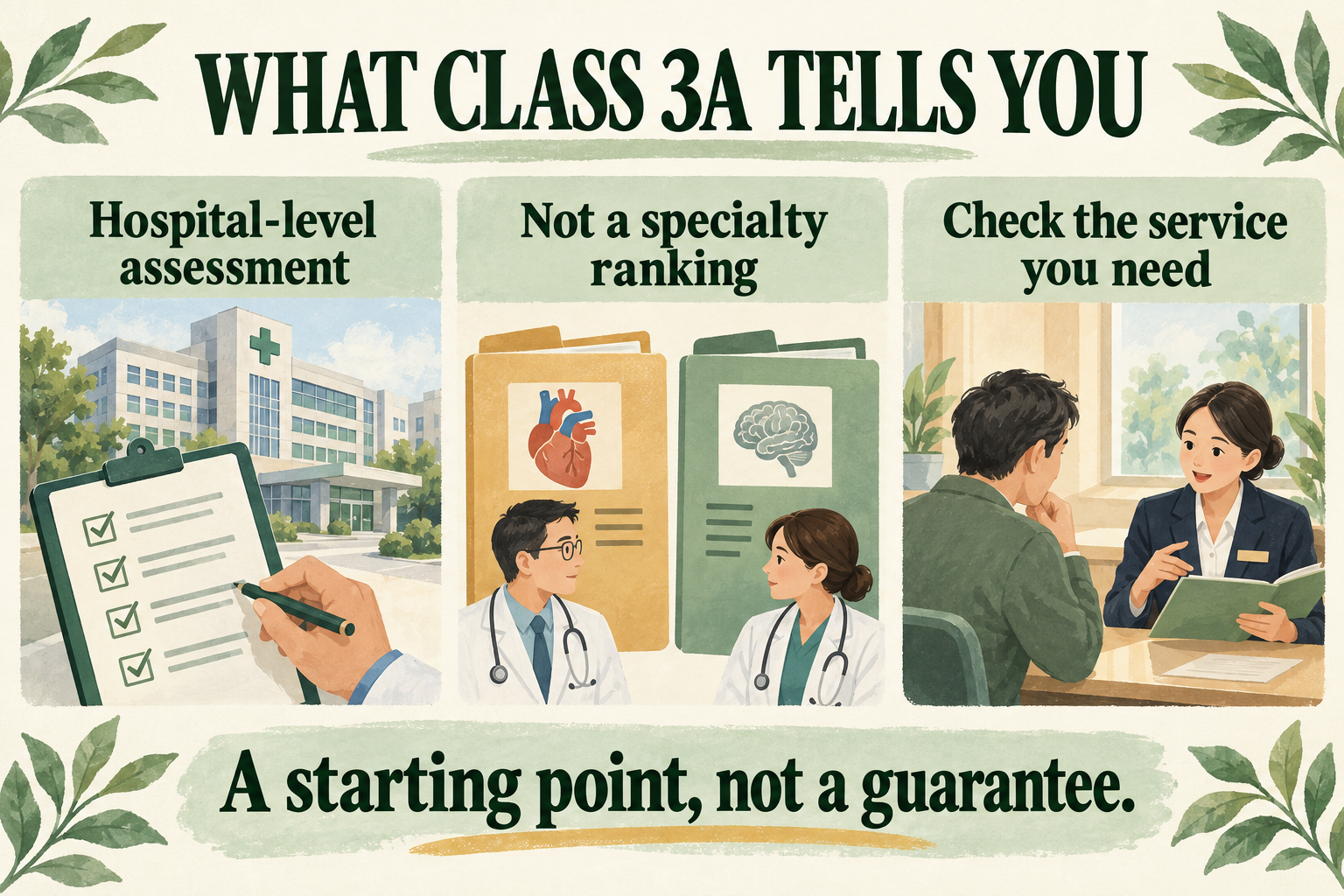
The Class 3A label tells you something useful about a hospital. It tells you much less about your doctor, the appointment you can book or the service you will receive.
By MedicCN, Editorial research · published 2026-10-15 · sources checked 2026-10-15
MedicCN editorial research based on the hospital and public-health sources linked below. Sources checked on 15 October 2026 unless the source says otherwise. This guide has not undergone independent clinical review. Inclusion does not imply a hospital partnership or confirmed access.

1. Class 3A is not a national league-table position
Class 3A, also written Grade III-A or 三甲, combines a hospital’s tertiary level with an A grade. At the end of 2025, 1,975 of China’s 38,159 hospitals held it, about 5%. It is an institutional classification, not a claim that the hospital is third in China—or that its doctors occupy the top of every specialty ranking.
The distinction matters when you search in English. ‘Tertiary hospital’, ‘Class 3A hospital’ and ‘top-ranked hospital’ are sometimes placed together in promotional copy, but they answer different questions. Tertiary identifies the hospital level; A identifies the assessment grade. Of the 4,267 tertiary hospitals counted at the end of 2025, 1,975 held the A grade. A ranking, if one is cited, needs its own publisher, year and subject.
The National Health Commission issued a new tertiary hospital assessment standard in 2025, replacing the 2022 standard and its implementation rules. The notice emphasises tertiary hospitals’ role in serious, urgent and complex conditions, alongside specialty services and support for other medical institutions. That provides context for the label; it does not select a doctor for you.
Use Class 3A as an initial institutional signal. Then move to evidence about the service relevant to your case. A directory that lists twenty hospitals with the same grade has barely begun the task of helping you choose between them.
2–3. The label does not rank every specialty or every doctor
An institutional grade cannot tell you which department best fits a particular problem, or whether the doctor you book works in the relevant subspecialty. Those are two separate decisions that still need making.
2. ‘All its departments must be equally strong.’ A large hospital may have many clinical services, while a specialist hospital concentrates on a narrower field. For a diagnosed cancer, the useful comparison might be between disease-specific teams rather than between two hospitals’ overall reputations. Zhejiang Cancer Hospital, for example, lists separate colorectal surgical and medical departments. Those names help you identify a route into care; the grade does not do that work.
3. ‘Any senior doctor at a 3A hospital will be the right doctor.’ Seniority and relevance are different. A clinician may work mainly on a particular condition, age group or stage of treatment. Read the official professional profile for the clinical focus, then match the appointment to your question. A review of a proposed operation and a discussion of drug treatment may call for different first consultations.
A practical enquiry should name the diagnosis or unresolved problem and explain what you want the appointment to decide. ‘I want your best doctor’ is difficult to route. ‘I need advice on the proposed treatment for this diagnosis’ gives the hospital a meaningful starting point.
4–5. Class 3A does not include an English service or a priority appointment
Language support and appointment access belong to the particular service you book. They do not follow automatically from the hospital’s grade.
4. ‘A 3A hospital will handle everything in English.’ Some hospitals publish dedicated international routes; others require more preparation for a foreign-language visit. PUMCH has announced an English website and bilingual-app booking route for foreign patients. That is useful evidence about a service, rather than a property you can infer from the label on the hospital sign.
An English booking page also leaves practical questions open. Who interprets the consultation? Can someone assist during tests and at the pharmacy? In which language will reports be supplied? Arrange the support that covers your actual visit, particularly if consent or treatment instructions will need interpretation.
5. ‘International or VIP care guarantees the senior specialist I want.’ A service name is not an appointment confirmation. HKU–Shenzhen publishes separate general and international booking contacts, illustrating why the exact route matters. Before travelling, you need the clinic, date, location and any required preparation. A reply saying that the hospital has received your enquiry does not reserve a slot.
6–7. The grade is neither a price list nor an outcome guarantee
A hospital’s assessment grade cannot tell you what your visit will cost or what result a treatment will achieve. Both require information specific to the service and the patient.
6. ‘The same grade means roughly the same bill.’ A consultation, imaging, pathology review and an admission are different services. The department and service category can also affect how a visit is quoted and billed. Ask for the items included in the proposed appointment, then separate any optional coordination or interpretation charge. Comparing two headline totals without the same scope is a poor way to choose.
7. ‘A 3A hospital guarantees a successful result.’ Institutional assessment is not a prognosis. A claim about a procedure’s success needs a defined patient group, outcome, follow-up period and source. For your case, ask the clinician about the expected benefits, important risks, alternatives and what may change the recommendation. Patient-rights information from Jiahui, for example, explicitly addresses explanations of treatment and participation in care decisions; those discussions remain necessary regardless of branding.
Before booking, try to complete one sentence: ‘I am seeing this department, through this service, to resolve this question.’ If you can add the appointment details and a clear explanation of the charges, you have moved beyond a reassuring label to an arrangement you can actually assess.
| Question | Useful evidence |
|---|---|
| Does the team fit my problem? | Official specialty profile and an enquiry directed to that service |
| Can I use the service? | Registration route and confirmed appointment |
| Will I understand the visit? | Agreed language support and report arrangements |
| What am I paying for? | A quote stating the service and its inclusions |
| What does the treatment mean for me? | The clinician’s explanation of benefits, risks and alternatives |