
Guides
Public or private hospital in China? A guide for international patients
The choice is wider than it first appears: ordinary public clinics, public hospital international departments and private international hospitals offer different routes into care.
By MedicCN, Editorial research · published 2026-10-10 · sources checked 2026-10-09
An editorial selection based on linked hospital and government information. Sources checked on 9 October 2026. This guide has not undergone independent clinical review; hospital inclusion does not imply a MedicCN partnership or a confirmed appointment.

Compare three routes, not just two kinds of ownership
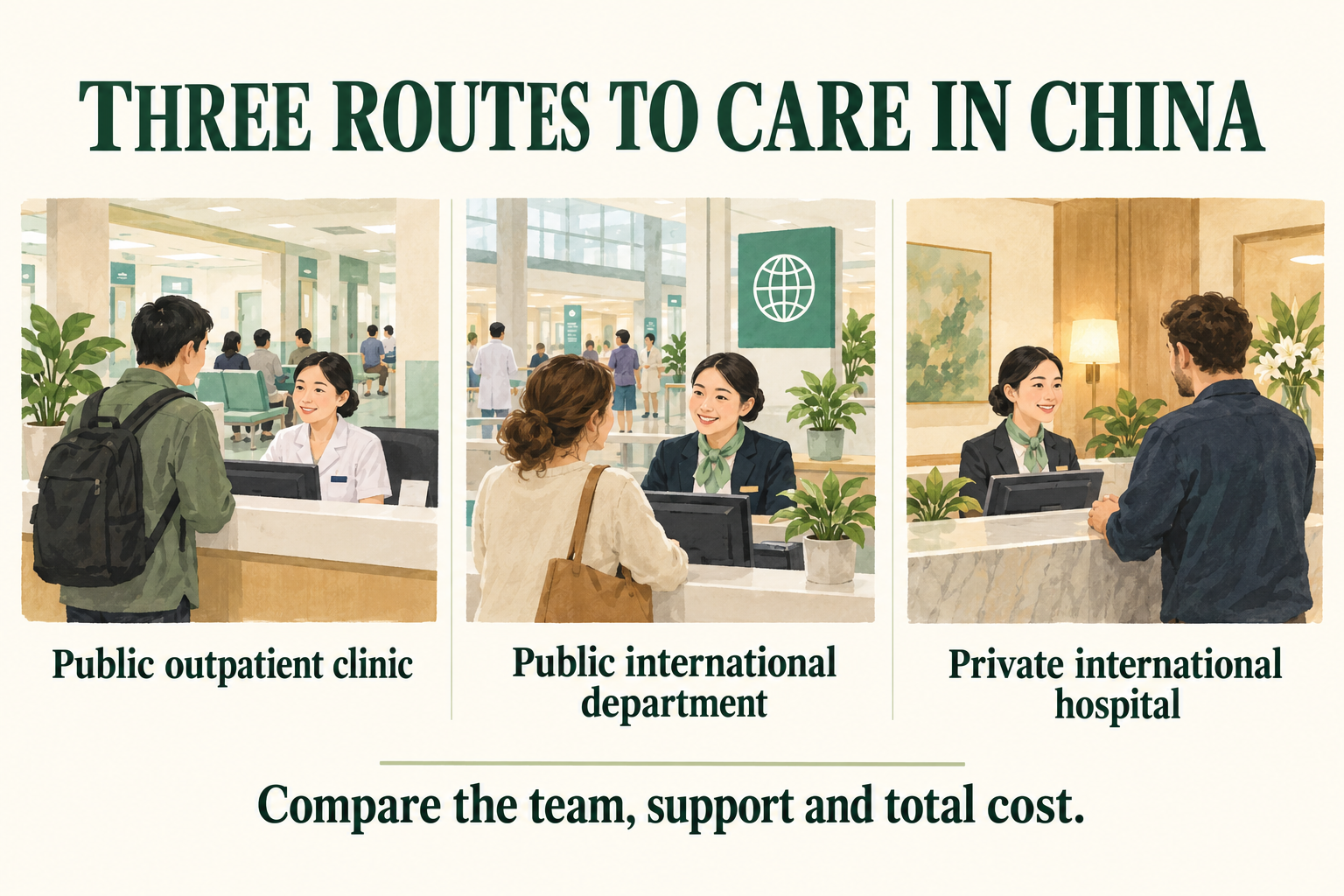
An international department inside a public hospital is a separate option from both its ordinary outpatient clinics and a private international hospital. For a foreign patient, that middle route can be the most useful part of the comparison.
PUMCH publishes an International Medical Services pathway. HKU–Shenzhen distinguishes ordinary and international booking. Private providers such as Jiahui and Beijing United Family publish their own appointment and patient-services routes. These examples show why ‘public or private?’ is only the first question.
For a specific diagnosis, begin with the relevant team. For a first assessment where the specialty is unclear, begin with an appropriate entry consultation. Then compare the service around it: communication, registration, billing, reports and subsequent appointments.
| Option | Reason to consider it | Main point to establish |
|---|---|---|
| Ordinary public outpatient clinic | A suitable specialist appointment through the hospital’s regular service | Can you complete registration and the visit with the language support you have? |
| Public hospital international department | A route to that hospital’s care through a dedicated service | Which specialists and investigations are available through this department? |
| Private international hospital | An appointment organised through a provider oriented to international care | Can the required care be delivered there, and how would a referral work? |
For complex care, choose the team before the room
A private room, a quiet reception area and an English website can make care easier to navigate. None establishes that a hospital is the right place for a particular operation or a difficult diagnosis.
A public specialist centre may be worth the additional travel and administrative work when you are seeking a particular clinical team. Ruijin’s official profile, for example, lists hematology and endocrinology; West China publishes a broad directory of medical and surgical departments. The useful next step is an enquiry to the relevant service, not an assumption about the entire hospital.
A private international hospital may be a practical place to begin when communication and continuity are your immediate priorities. But it deserves the same clinical questions: who will assess you, what investigations can be performed there, who would undertake a proposed procedure, and where would care continue if you needed a service it does not provide?
It can also be reasonable to use more than one provider—for example, an initial assessment close to where you are staying and a later specialist opinion elsewhere. Before doing so, settle who will interpret the results and hold the current treatment plan. Two appointments are not automatically coordinated care.
Buy the support you need for the whole visit
The difference you notice most may be outside the consultation room. Registration, investigations, pharmacy instructions and discharge paperwork also require clear communication.
Jiahui’s patient-rights statement addresses interpreter assistance. Beijing United Family’s patient-services page describes multilingual support and a route for requesting records. These are useful service details to investigate. They do not make it safe to assume a specific interpreter or translated document is included in every appointment.
For a public international department, ask which parts of the visit its staff will help arrange. You may be consulting a specialist in the wider hospital while using the international service for booking and administration. Establish where tests take place and whether language support accompanies you.
For an ordinary clinic, an independent interpreter can be useful if the hospital permits the arrangement. Agree on the scope: a consultation only, several hours including tests, or a separate return visit. Waiting time can change the amount of support needed, so a clear fee basis matters more than a vague promise of ‘full assistance’.
Compare a defined episode of care, not a headline price
Ask what you would pay for the same next step at each provider. A consultation fee cannot tell you the cost of investigations, a procedure or the full course of care.
Start with the consultation: the clinician, department, appointment type and price. Then identify what is separate—interpretation, tests, a return appointment to discuss results, record copies or translation. If treatment is proposed, request an itemised estimate with its assumptions and the situations that could change it.
For surgery, distinguish professional fees, the operating room, anesthesia, implants or consumables, inpatient accommodation and follow-up. Not every hospital will be able to quote before examining you. A useful estimate makes that uncertainty visible instead of presenting an incomplete starting price as a final bill.
A hospital’s direct-billing relationship with an insurer is not confirmation that your policy covers the visit. Ruijin’s official profile lists insurers, but your specific provider, department, treatment and policy still need to match the authorisation. Obtain confirmation from the insurer and hospital before relying on direct billing. If you are paying yourself, establish the deposit and settlement arrangements.
There is no defensible single price multiplier for ‘private versus public’ across China. Without matched, dated estimates for the same service, a neat percentage saving would conceal more than it explains.
Choose the service that can carry the plan through
For an identified specialist need, prioritise the team and a workable access route. For a first visit without a clear diagnosis, prioritise a suitable clinician, understandable communication and a reliable next step.
A public international department is worth considering when your preferred team is based at that public hospital and you need additional help navigating it. A private international hospital is worth considering when its clinical scope fits and its patient-services arrangements suit the visit. An ordinary public clinic can be a workable choice when both the booking route and language support are settled.
Before committing, put the two actual options side by side: appointment date, doctor or clinic, campus, language support, initial costs, report access and follow-up. Where an item is unresolved, leave it unresolved rather than filling the gap with the hospital’s reputation.
Aftercare belongs in the comparison from the start. Find out who will explain delayed results, review progress and provide the records needed by your doctor at home. The better choice is the one that can address your medical need through a service you understand and can use.