
Guides
10 hospitals in China to know when choosing cancer care
From Beijing and Shanghai to Guangzhou, Shenzhen and Chengdu: ten cancer-care options, the departments worth looking at, and how to turn a hospital name into a useful enquiry.
By MedicCN, Editorial research · published 2026-10-15 · sources checked 2026-10-15
MedicCN editorial research based on the hospital and public-health sources linked below. Sources checked on 15 October 2026 unless the source says otherwise. This guide has not undergone independent clinical review. Inclusion does not imply a hospital partnership or confirmed access.

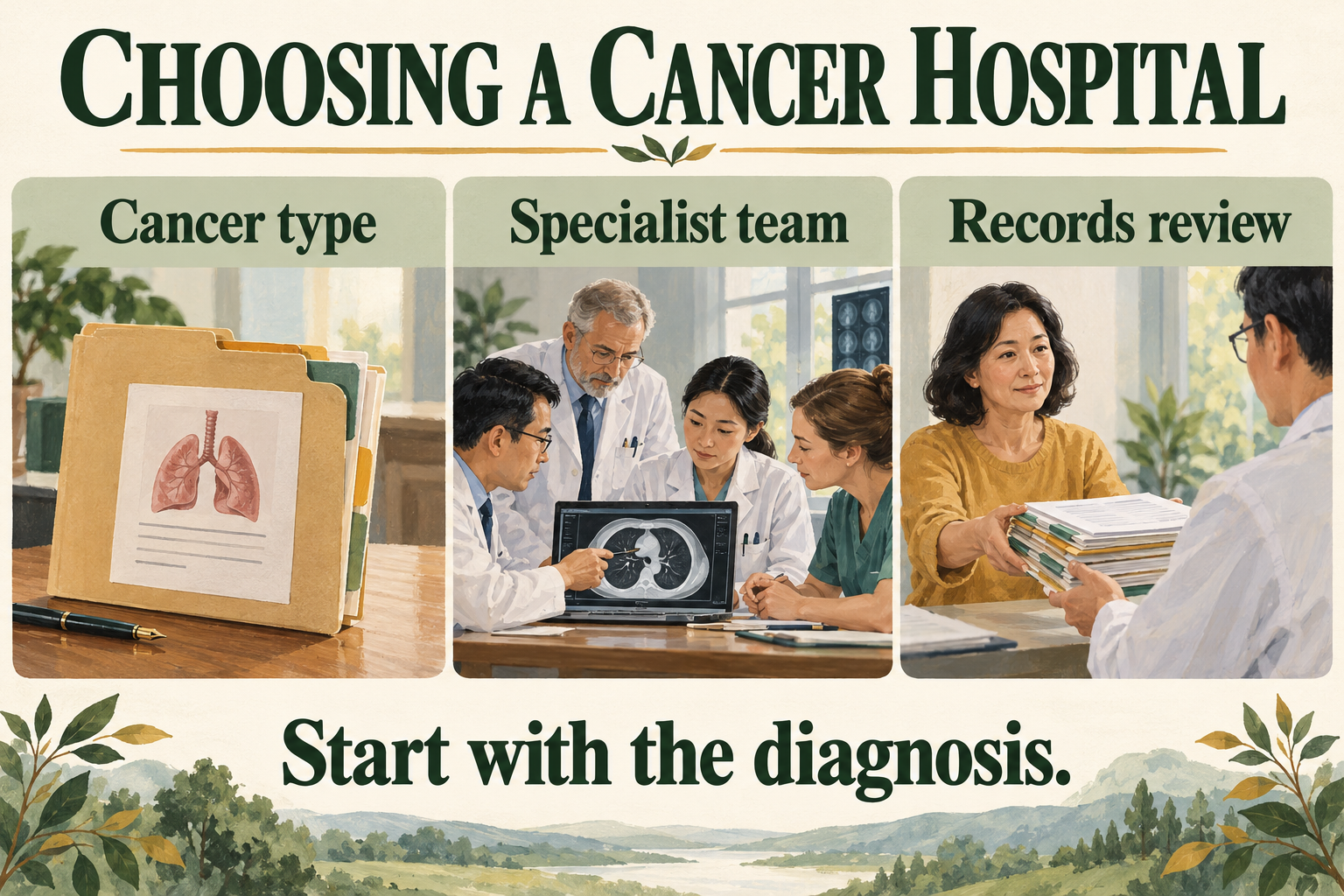
Start with the cancer type, then the hospital
For a defined cancer diagnosis, begin with the team that treats that disease. Sun Yat-sen University Cancer Center offers a published international-service route in Guangzhou; West China Hospital has a dedicated lung cancer centre in Chengdu; Zhejiang Cancer Hospital separates several cancers into surgical and medical departments. Those distinctions are more useful than a single overall position on a list.
A family researching breast cancer and a patient seeking advice on a lung tumour may need quite different clinics within the same institution. Even the word ‘oncology’ can hide several routes: a surgeon’s assessment, drug-treatment advice, radiotherapy planning or a review involving more than one specialty. Take the wording of the diagnosis from the report when you enquire, and state the decision you are facing.
The ten hospitals below are a starting shortlist, grouped by location. Each has a verifiable cancer-care service. Their inclusion does not establish comparative survival, a place in a national league table or availability for an individual patient. For international visitors, the next practical distinction is whether the hospital publishes a dedicated international route or whether ordinary registration needs to be arranged.
Beijing, Tianjin, Shanghai and Hangzhou: five starting points
These five institutions offer a useful first search across northern and eastern China. The department name should drive the enquiry; a familiar hospital name alone will not identify the right appointment.
1. Cancer Hospital, Chinese Academy of Medical Sciences, Beijing. Often shortened to CAMS Cancer Hospital, this is a dedicated cancer institution. Begin with its official patient and department pages, using the full diagnosis rather than asking for a generic cancer appointment. Keep ‘Beijing’ in the enquiry: the Shenzhen hospital below has a separate booking route.
2. Peking University Cancer Hospital, Beijing. Its official directory includes gastrointestinal cancer centres, thoracic surgery, hepatopancreatobiliary surgery and a breast centre. For a digestive-system cancer, identifying the organ and the purpose of the visit helps narrow a large directory into an actual clinic.
3. Tianjin Medical University Cancer Institute and Hospital. Its directory includes breast services and interventional oncology. A patient exploring breast-cancer care should identify whether the current question concerns surgery, systemic treatment or another stage of care before choosing a clinic.
4. Fudan University Shanghai Cancer Center. The hospital describes multidisciplinary, disease-focused care across its Xuhui and Pudong campuses. Campus confirmation matters here: an appointment at a well-known institution is still an appointment at a particular location and service.
5. Zhejiang Cancer Hospital, Hangzhou. Its directory gives particularly concrete starting points: colorectal surgery and colorectal medical oncology, breast surgery and breast medical oncology, plus separate radiation departments. These are useful options to discuss with the referring clinician when deciding which assessment comes first.
Guangzhou, Shenzhen, Wuhan and Chengdu: five more to consider
Southern and western China deserve a place on the shortlist, especially when a suitable team is closer to your home or support network. Guangzhou also offers a clearly documented international entry point for cancer enquiries.
6. Sun Yat-sen University Cancer Center, Guangzhou. Its International Medical Center publishes appointment contacts and describes multidisciplinary input into care. This makes it a practical first enquiry for an overseas patient who wants an identifiable coordination route. Use gjylb@sysucc.org.cn for that service, and include the diagnosis and purpose of the proposed visit.
7. Cancer Hospital, Chinese Academy of Medical Sciences, Shenzhen Hospital. The official site links clinical departments, specialist appointments and visit procedures. It is a separate destination from CAMS in Beijing. For someone based in the Greater Bay Area, it is worth exploring before assuming cancer assessment requires travelling north.
8. Hubei Cancer Hospital, Wuhan. The hospital publishes a breast centre and other tumour-specific services. It adds a central-China option for patients whose family support or existing care is in the region. Start with the relevant clinical service rather than choosing Wuhan on the assumption that every cancer pathway is interchangeable.
9. Sichuan Cancer Hospital, Chengdu. This specialist institution describes multidisciplinary teams and publishes a department directory, including paediatric oncology. An enquiry for a child should state the patient’s age from the beginning; an adult oncology appointment is not a substitute.
10. West China Hospital, Sichuan University, Chengdu. This is a general hospital with substantial cancer services. Its lung cancer centre brings together several disciplines, while its abdominal oncology department covers digestive, urinary and gynaecological cancers. It is a useful option to explore when the question spans cancer treatment and other medical problems.
Reduce ten names to two useful enquiries
Choose two hospitals with a relevant department and a workable access route. Send both the same concise question so that their replies can inform a real decision.
A useful opening is: ‘I have a confirmed diagnosis of [condition]. My treating team has proposed [plan]. I would like an opinion on [specific decision]. I have the pathology report, imaging and treatment summary. Which service should receive my enquiry?’ This gives a coordinator enough context to direct the request without filling a first message with sensitive attachments.
Look for the substance in the reply: the proposed specialty, whether records are needed before scheduling, whether a visit is required, the scope of the consultation and the quoted charge. A records acknowledgement is not a clinician’s opinion. Likewise, a consultation offer is not an offer of surgery, admission or a particular medicine.
For continuing treatment, include the practical questions that will affect daily life: how often attendance may be needed, who handles problems between visits and how records can be shared with your existing team. Do not interrupt a current treatment plan or postpone urgent care while waiting for an overseas enquiry. The useful shortlist is the one that leads to an informed consultation and a feasible care arrangement.