
Guides
Hong Kong or Shenzhen for medical care? Start with the appointment you can use
How eligibility, the treating team, fees and cross-border records change the decision—and when keeping care in one place makes more sense.
By MedicCN, Editorial research · published 2026-10-15 · sources checked 2026-10-14
MedicCN editorial research. Sources checked on 14 October 2026; older source dates are identified where relevant. This guide has not undergone independent clinical review. Hospital inclusion does not imply a partnership or confirmed access.
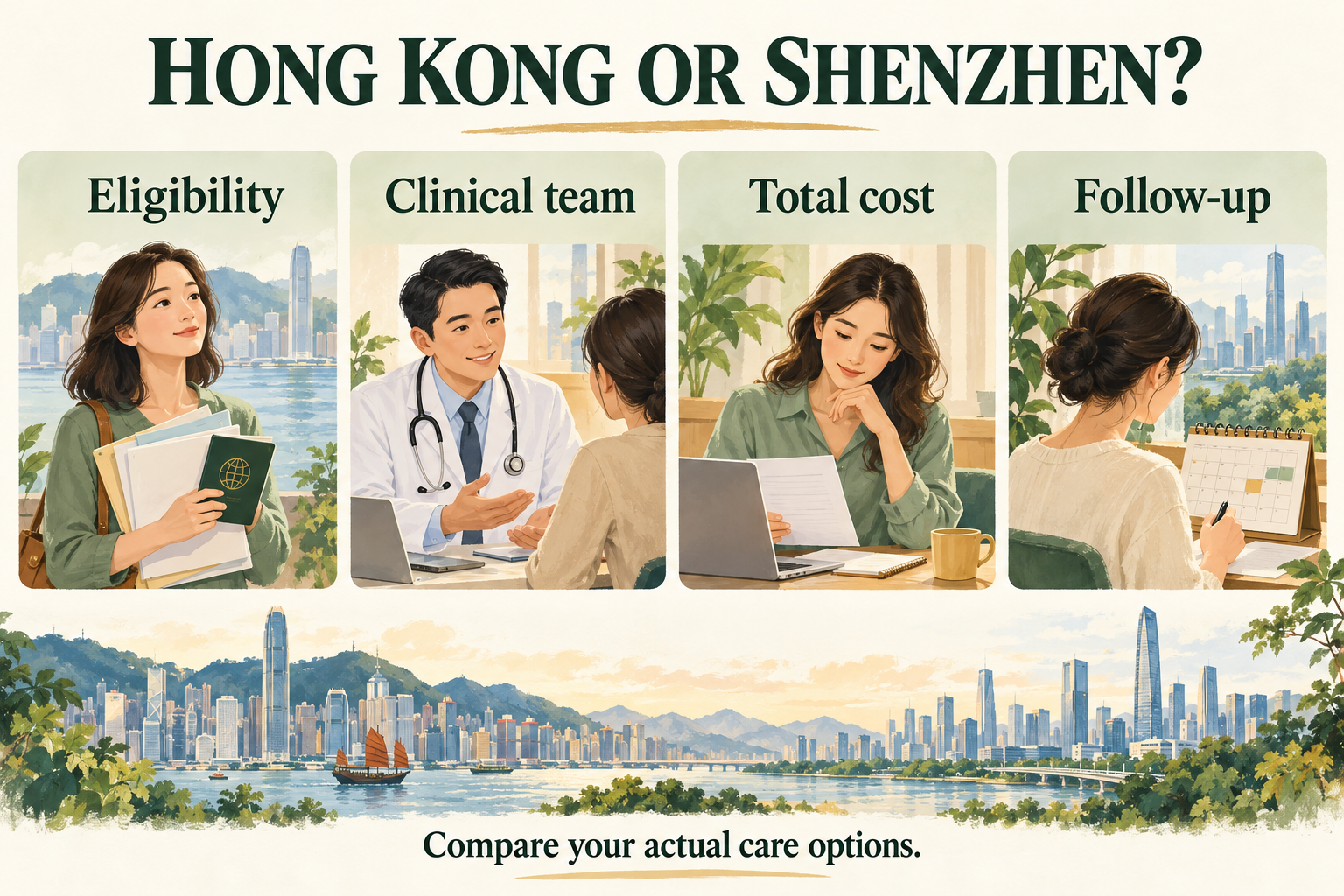
Keep an established care team unless crossing solves a clear problem
For ongoing treatment, an existing clinician and a reliable route back to care are strong reasons to stay where you are. Shenzhen becomes a useful alternative when a suitable team has accepted the case and the complete arrangement works better for you. A city’s reputation is too broad a basis for that decision.
Our practical judgement is to favour continuity for care involving repeated reviews, changing medicines or recovery support. For a defined consultation, an alternative across the border may be easier to assess: a named specialty, a confirmed date, a clear fee and a plan for the result.
Separate the options into Hong Kong public care, Hong Kong private care, Shenzhen ordinary public care and Shenzhen international or private services. These are different purchasing and access routes. Comparing a subsidised public tariff with an international clinic’s private quote would obscure more than it explains.
| Decision | Hong Kong option | Shenzhen option |
|---|---|---|
| Access | Public eligibility or private booking route | Ordinary, special-service or international route |
| Clinical fit | Named specialty and proposed care | Named specialty and proposed care |
| Communication | Consultation and report language | Consultation and report language |
| Cost | Applicable HKD tariff or written quote | Applicable RMB tariff or written quote |
| Continuity | Where results and complications are managed | Where results and complications are managed |
Hong Kong public fees depend on eligibility
From 1 January 2026, the Hospital Authority lists an eligible-person specialist outpatient attendance at HKD 250, with a separate HKD 20 per drug item. Its acute inpatient daily rate for eligible persons is HKD 300; the non-eligible general-hospital inpatient rate is HKD 7,400 per day.
These are specified public-service tariffs, not complete private-treatment quotations. The eligibility rules include qualifying Hong Kong identity-card holders, with an exception where the relevant permission to remain has expired or ceased, and other defined groups. Nationality alone does not resolve eligibility.
Have the receiving service establish which category applies before using a published fee in your budget. A visitor should not assume access to the subsidised rate. Equally, a patient entitled to subsidised care should not assume that crossing the border saves money simply because an advertised mainland consultation is inexpensive.
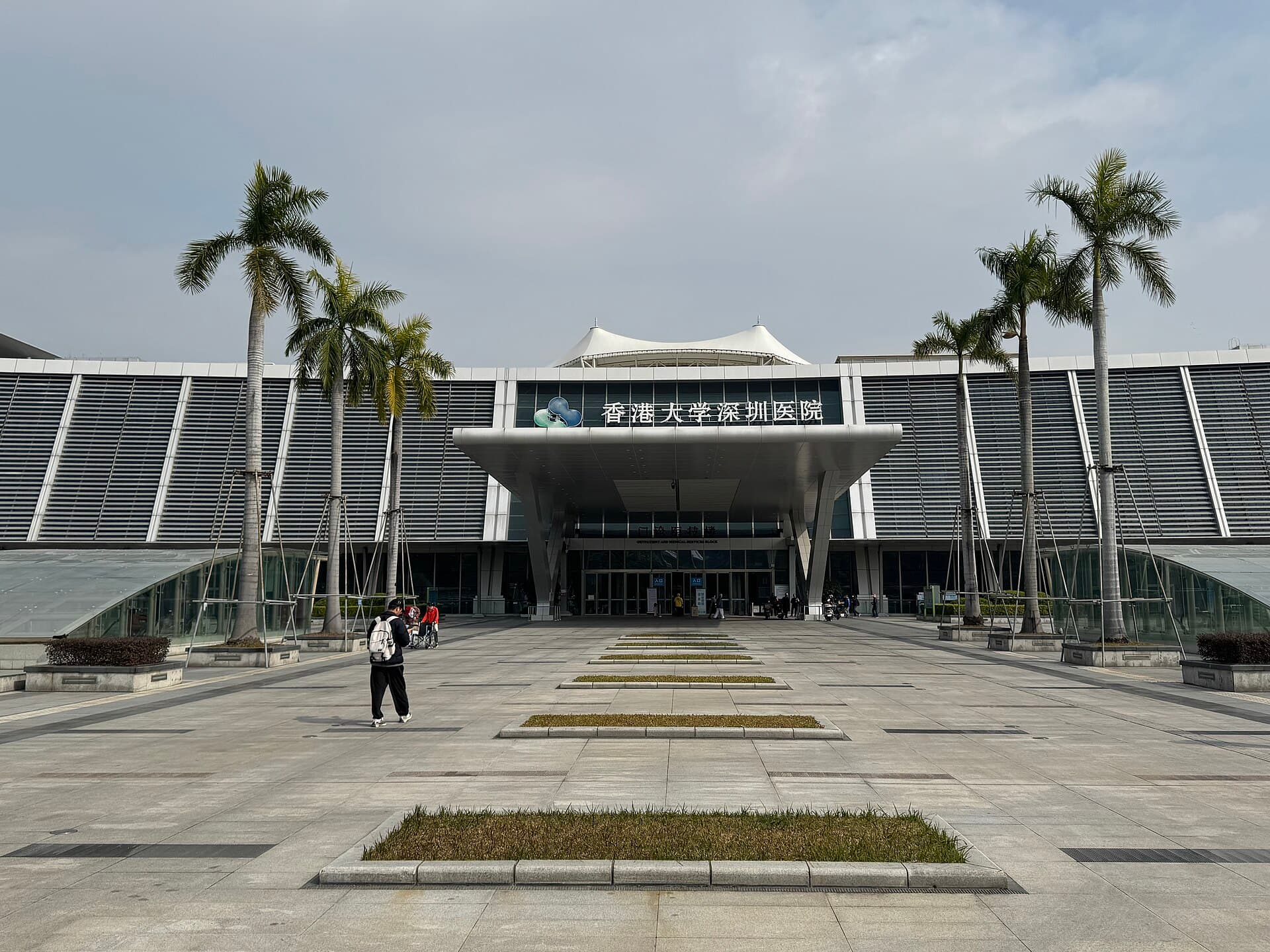
Choose a Shenzhen service, not simply a Shenzhen hospital
HKU–Shenzhen provides separate general and international booking routes. The hospital’s Hong Kong connection does not mean that a Shenzhen appointment uses Hong Kong Hospital Authority prices, eligibility rules or records systems.
Ask which department will see you and under which service category. If the purpose is a second opinion, define the question and send the records the receiving team requests. If treatment is the aim, establish whether the proposed visit is only an assessment or whether further arrangements have actually been made.
Language needs should follow the entire visit: the clinical conversation, consent, preparation sheets and the final report. An English-speaking booking contact does not by itself establish all of these. Use the hospital’s response to decide whether interpretation or translation is needed.
Compare written estimates for the same planned episode, keeping HKD and RMB clearly labelled. Add transport, any overnight stay and repeat visits separately. Do not use an assumed exchange rate or an advertised starting price to claim a saving before the scope is matched.
Cross-border record sharing helps, but is not automatic
Hong Kong’s eHealth cross-boundary arrangements require authorisation and participation by designated institutions. Do not assume that a doctor can see your history simply because you have used a hospital on the other side of the border.
The March 2026 eHealth update describes access to selected records from the previous three years. It also describes authorised deposit of radiology reports and images by three participating Greater Bay Area hospitals from January 2026, including HKU–Shenzhen and Shenzhen New Frontier United Family.
Check whether you and the receiving institution can use that service. In parallel, keep readable copies of the referral, medication list, relevant reports and imaging. Agree who will review results that arrive after the visit. A file transfer does not automatically create a follow-up appointment or clinical responsibility.
Plan the return journey around the care
A convenient border crossing does not make every procedure a suitable day trip. Sedation, an intervention or a change in the treatment plan can alter the journey home.
For a procedure, ask the treating team about an escort, observation and any travel restrictions before booking transport. Keep enough flexibility for a review if needed. If you need urgent help afterwards, use appropriate local emergency care rather than delaying treatment to reach the original hospital across the border.
Before committing, write down four answers: who will see you, what the visit is expected to achieve, what it is likely to cost and who handles the next step. If the cross-border option has clear advantages on those terms, it is worth considering. If it fragments an otherwise workable treatment plan, staying with the current team is often the stronger choice.