
Guides
Your first hospital visit in China: 10 things that can catch you out
The wrong campus, an unconfirmed booking, a test that needs another appointment: the small details that can turn a straightforward visit into a long day, and how to handle them.
By MedicCN, Editorial research · published 2026-10-10 · sources checked 2026-10-09
An editorial selection based on linked hospital and government information. Sources checked on 9 October 2026. This guide has not undergone independent clinical review; hospital inclusion does not imply a MedicCN partnership or a confirmed appointment.

1–2. A hospital name and a booking request are not enough
Leave for the hospital with a confirmed appointment and an exact destination. The name you recognise may refer to several campuses, and a message acknowledging your request may not reserve a slot.
1. Arriving at the wrong campus. Save the Chinese hospital name, campus, building and entrance from the confirmation. Send that address to the driver. Do not select a map result solely because its English name looks right. Shanghai’s hospital directory often specifies the building and floor for an international service; that level of detail is useful precisely because a large hospital has more than one entrance.
2. Treating an enquiry as a booking. A reply asking for records is a step towards an appointment. Look for the actual date, time and clinic or clinician. If the reply does not give them, resolve the booking before travelling. PUMCH publishes official online routes for foreign patients; other hospitals may use a different process. A third-party message should not replace the hospital’s confirmation.
For a first visit, allow time for registration and finding the department. Ask the hospital when to arrive rather than assuming the appointment time is also the time to walk through the front gate. Keep the confirmation available offline in case your connection fails.
3–4. Your passport record and the clinic type need to match
Use your own identity details, then confirm whether you have booked an ordinary clinic, a special-service clinic or an international department. Those choices can change the location, administration and charges.
3. Getting stuck at first-time registration. Bring the original passport and any existing hospital card or patient number. Shanghai’s guide identifies the passport as a registration document. If an online form rejects it, ask the hospital which route foreign-passport holders should use. Registering under a friend’s identity creates a mismatch in medical records; it is not a practical workaround.
4. Booking a different service from the one you intended. A doctor may appear in more than one clinic, and an English-language hospital page may describe a particular international service. HKU–Shenzhen’s booking guidance distinguishes ordinary and international routes. When a fee or appointment differs from what you expected, check the service type as well as the doctor’s name.
At reception, confirm how to check in for the department and how the queue works. The hospital’s general registration record and the clinic’s arrival check may be separate. Keep any ticket or patient number until the visit is finished.
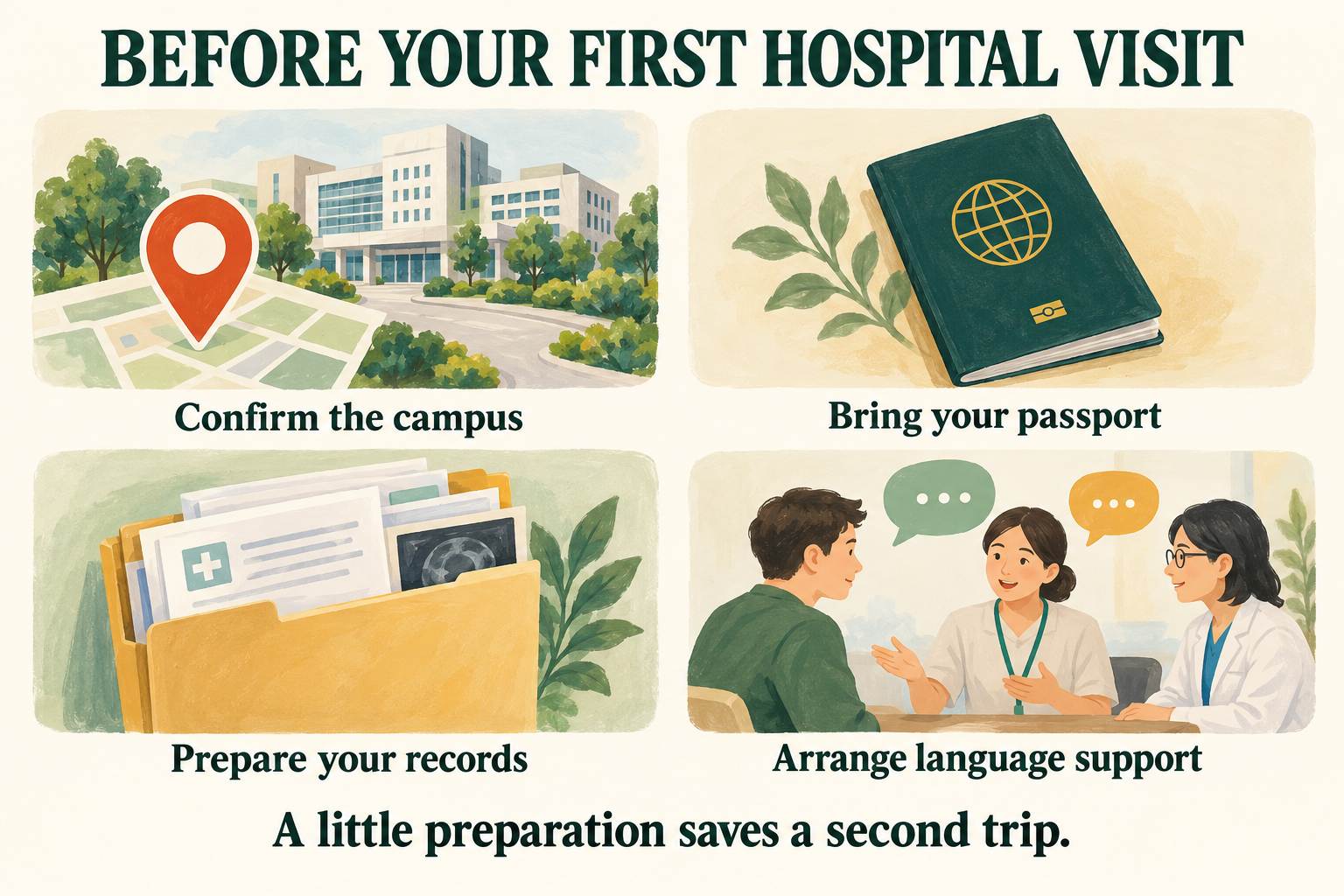
5–6. The records and the language arrangement need preparing
The clinician needs a usable account of the problem, and you need to understand the discussion. Organise both before the appointment rather than using the consultation to search your phone for missing information.
5. Bringing fragments instead of a history. Put the main concern, dates, established diagnoses and previous treatment on one page. Keep reports in date order, with the original documents beside any translations. If the visit concerns a previous operation, include its report and discharge summary. A picture of a scan is not necessarily the image file the clinician needs; ask the hospital what to bring.
6. Assuming someone will translate everything. An English-speaking doctor may not accompany you to a cashier, a laboratory or a pharmacy. If you need an interpreter, specify the parts of the visit to be covered. Jiahui’s patient-rights policy includes assistance with understanding care, and Beijing United Family publishes language-support information; the arrangement still needs to be made for the particular visit.
Write down your most important questions. At the end of the consultation, repeat the next step back to the clinician: what the test is for, what happens after the result and when you need to be seen again. If that explanation is unclear, this is the moment to pause and clarify it.
7–8. An order, a payment and a test appointment are different things
A clinician ordering a test does not necessarily mean you can have it immediately. Find out where it is performed, whether it needs booking or preparation, and what has to be paid first.
7. Assuming every investigation will happen the same day. Ask the test department for its actual appointment and preparation instructions. Some results may be available quickly; others need a later review. Avoid making a return flight depend on the assumption that one clinic appointment will complete the assessment.
8. Paying one fee and expecting it to cover the day. Shanghai’s guide describes separate payments for registration, investigations and prescriptions. A particular hospital or international service may handle billing differently. At each stage, identify what the charge is for and keep the receipt; ask which payment methods the relevant department accepts before relying on a single card or phone app.
If you expect insurance to pay, settle authorisation before the visit where possible. A card bearing the insurer’s logo is not proof that the hospital can bill your policy for this appointment. If you pay yourself, request the itemised paperwork you will need for any later reimbursement claim.
| Question | What the answer should establish |
|---|---|
| Is this booked or only ordered? | An actual date, time and location |
| How should I prepare? | Instructions from the team responsible for the test |
| When and how will I get the report? | A collection or download method and expected timing |
| Who will explain the result? | A clinician and a follow-up arrangement |
9–10. Collect the explanation as well as the medicine and reports
Finish the visit with clear medication instructions and a plan for results, review and records. These are the details that become harder to resolve once you are back at your hotel—or in another country.
9. Leaving the pharmacy without understanding the prescription. Ask the pharmacist to confirm the medicine, dose, timing and duration, and tell the team what you already take. Keep the original packaging and instructions. Do not infer a dose from the number of tablets in the box or assume a familiar brand name means the same strength.
10. Leaving without a route to the results or the next appointment. Ask which reports are ready, which are outstanding and whether the review requires a new booking. Confirm how to request copies and whether English documents are available. Beijing United Family, for example, publishes a records-request process; do not assume every hospital releases records in the same way.
Before you go, save the hospital contact, your patient number, the next appointment and the instructions about seeking help if your condition changes. For a planned visit, those details turn a collection of separate hospital stops into a usable care plan. If a problem is urgent, seek local medical help instead of waiting for a routine follow-up slot.